Superintendent Bachmeier Visits Stanley Schools
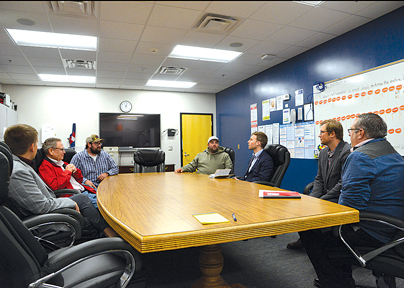
Superintendent of Public Instruction Levi Bachmeier has a goal to visit every public school district in the state. With his stop in Stanley on Friday, Nov. 6, he was marking the 73rd stop on that tour of 167 districts. He had also visited New Town earlier that day.
The goal is to understand and appreciate each school’s challenges, differences and successes. He said that they want to work in partnership with the schools and the legislature to support schools to be the best possible. Part of these meetings are to find out what schools are most proud of along with the challenges they face and how the department can best help them.
As he met with members of the school board and administration, they discussed staffing challenges. While Stanley has been able to keep good staff, the challenge can be in filling open positions. For Stanley Schools this year, that is an unfilled counselor position. Based on the number of students, Stanley should have a third counselor. They have advertised, interviewed and offered the third position with no success. The requirements for a school counselor can also make filling those positions difficult. Meanwhile, other open positions have been filled as paraprofessionals make the transition to teachers. The local mentorship and experience in the classrooms gets them ready to step in.
Bachmeier also discussed the over 250 unfilled positions across the state. There are 323 international teachers in districts across the state. He said that part of the challenge is changing the way a career in education is looked at. He says that it needs to be seen as a financially sustainable and meaningful career.
They also discussed the challenges with increased health insurance costs. Stanley saw a 20% increase this year after 16% the previous year. They also will lose their grandfathered plan next year. That leaves Stanley, along with many other districts, researching their options to provide coverage for staff.
As for the financial issues facing schools, the 3% cap has not yet affected Stanley, but they also noted that being responsible stewards of resources can also penalize districts if they need to increase their mill levies. Bachmeier noted that the funding formulas need to keep up with inflation, closing the gap for districts. Education and public safety both need to be a legislative focus.
As they talked about challenges, part of the discussion focused on resources with social services and mental health needs for students. There is a need to make sure that the communication pieces are in place and the services available for schools to help their students succeed. The impacts are felt by administration, teachers and everyone else in the building when the system is falling short.
There was discussion about standardized testing and ways DPI is looking on the accountability portion that allows more alignment for data and student growth, celebrating and recognizing all signs of growth in students.
Bachmeier also met with the senior class, where he asked students the best part of going to school in Stanley. They pointed out the relationships with teachers, scheduling flexibility that allow students to enter the workforce, community and again the feeling that teachers are invested in their students’ success.
Bachmeier asked what students were considering for their future, including postsecondary education, workforce or military. He also asked what it would take for them to consider becoming teachers. Students noted that challenges include the pay, requirements and a lack of respect they feel that teachers see.
When he was asked about his feelings about AI, he said that it holds a lot of promise for teaching. He also said it is important for students to know how to use it in a basic way and understand the value. He pointed out that students need to not use it to outsource their own thinking and learning processes. Finally, he asked students to avoid using the companion chat bots, but rather make the human connections with someone to talk to.
He pointed out to students that education is complex. Success in schools needs to be measured outside of the old standards. They need to recognize perseverance, accountability, and competitiveness in addition to the test scores. He said that the challenge is finding that balance.