NWLA Holds Annual Meeting
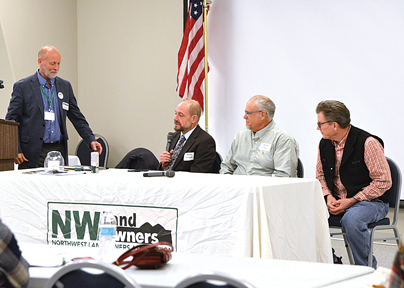
The Northwest Landowners Association held their annual meeting at the Mountrail County South Complex on Monday, Dec. 15. This year’s meeting included hearing from industry representatives on lithium extraction, power needs and rare earth minerals. They also heard from a farmer and member of the ND Community Alliance on high-level nuclear water. NWLA legal counsel Derrick Braaten updated members on the most recent lawsuit and then joined in on discussions regarding the last legislative session.
The first speaker of the day was Paw Juul who attended via Zoom. Juul works for a Danish company that works with lithium extraction. He gave an overview of how that process works. They are looking at ways to use produced water. The process would remove lithium from produced water using an extraction facility. Once that is removed, the produced water is reinjected. Tanks extract the lithium, process it further and concentrate it to convert it to carbonate. It is then dried and can be sold.
He said his company continues to optimize the process, using as little chemical as possible. They reuse as much water as they can to reduce how much fresh water they need. They design, build, own and operate their facilities. In some projects they are also part of joint ventures. Because they have skin in the game, they are there for the long run hoping to see facilities and the industry grow.
The company is part of two projects in northwest North Dakota, although Juul was unable to disclose the locations or the company names.
State Senator Mark Enget gave remarks, saying that he understands property rights as a landowner, having purchased the family farm. He also has his background in the oil industry, which he says has him working to reconcile the ability for the two to work together.
He discussed his first legislative session, saying that he is a conservative. He wants to be fiscally conservative as well, noting that the state needs to be prepared for the time the oil industry tapers off.
He said that first session was a learning curve, but he is there to serve the residents of his district. He encouraged them to reach out about the things that matter to them. He wants to hear them and do his best for them.
Andy Buntrock of Basin Electric Power Cooperative was the next speaker of the day. He discussed the cooperative itself, saying that their service area feeds and fuels the world.
He also talked about the increased need for generation capacity. They want to make sure they meet the needs of their members to ensure reliability while also meeting the growing needs.
He said they expect a tremendous amount of growth including with their traditional member load which has seen a 100% increase over the past fifteen years. There is also the projected large load growth coming. Basin has created a package for those large load projects that requires them to bring skin to the game. That matters because of the increasing costs of power generation and transmission lines.
The company is seeing big requests for the large load users including one existing in the Bismarck/Mandan area, as well as Fargo/Moorhead and Sioux Falls.
Their five step approach to growth is to try to serve those loads while protecting and insulating their existing customers when it comes to rates.
The company also continues to make investments in reliability, taking care of what they have while building new stations like the Pioneer station near Williston and the Bison station near Wheelock. They are also building substations and transmission lines. Both of those new stations are for traditional load growth.
Levi Moxness of the Division of Mineral Resources was the next speaker, talking about critical and rare earth minerals. The geological survey department has been working to gather information and lay the geological framework for that type of development.
He said that in the 1980s, North Dakota was a leading producer of rare earth minerals. China invested heavily in the process in the 2000s and soon was responsible for 90% of the supply.
For the last ten years, trade wars have put rare earth and other mineral commodities at the forefront. The supply has been disrupted and economies contract as a result.
Moxness talked about lignite coal as a source for the rare earth minerals, saying that coal is easier to mine and less work than hard rock layers. UND is working on extracting techniques to make this process economic.
He said they are doing exploratory drilling and looking for those lignite lines that are the result of long abandoned mines in the state. They have looked at two enriched zones so far in the Bear Den and Rhame Bed foundations. They also have identified at least one more good source in Adams County so far.
He noted there are potential economic locations throughout western North Dakota making this a potential new economic play. Meanwhile they are still in the investigative process looking at the possibilities.
Bob Grant offered the noon prayer before lunch, thanking God for the opportunity to enjoy the miracle of each day. He said that in this time, it is important to raise up wise and virtuous leaders while kindling a respect for each other. He asked for guidance to use the talents give to them to inspire to serve with wisdom.
Following lunch, Grant also shared his thoughts about the freedoms we enjoy and the sacrifices that made it possible. That included his thoughts of his family members and friends on Memorial Day, the 4th of July and Veterans Day.
He said he thinks of the 250 years as a democratic republic and the checks and balances of the three branches of government. He reflected on how that democracy has been challenged many times, but he is confident that working together it can meet the challenges. But he also says that the majority is obliged to protect the rights of the minority.
He reflected on how the NWLA is challenged more in each legislative session to protect landowner rights. The NWLA principle remains the same. They are not opposed to development, rather they want to see cooperative efforts for development and protection of those natural resources to turn over to the next generation.
He said that the development of one resource should not be at the expense of another. Farming and ranching is a life dependent on the land as they work to be stewards of the land, leaving a legacy. He said they fight to protect those rights and lands, even when they get discouraged because if they don’t, who will?
He also says that he wonders what it would look like if the NWLA had not gotten involved. They look for ways to reach more people, encouraging them to share their stories. Eventually the concerns and battles will affect all citizens of North Dakota and responsibility demands actions.
He said that he is not against development, he knows it is needed. He just wants everyone to be treated with dignity and respect, leaving a legacy to be proud of. He said he is proud to know they have made an impact for a cause they believe is very worthwhile, wanting to leave a heritage behind.
Blaine Schmaltz, a fourth generation family farmer and member of the ND Community Alliance spoke to the attempts for disposal of high-level radioactive waste in the Rugby area. Ten years ago, the Department of Energy announced a $30 million grant to UND to do a geological survey in Pierce County that would then be turned over to the department to dispose of waste from Hanover, WA.
Landowners were alarmed as they looked for additional information. They started to work with their County Commissioners to enact codes. They testified to the legislature. They had community gatherings and got very active in the process.
He said that they continue the battles, even as the last legislative session started talking about nuclear energy.
He said they are looking for help from townships and counties, encouraging them to clean up their ordinances so they do not become a dumping spot. He said they will continue looking for a weak link to find their way into the state.
He said that their organization will also need assistance as they look to modify Century Code to keep these things at bay. The goal is to get a long-term site regulation, not allowing companies to use the phrase “temporary storage” which actually turns into long-term storage.
Troy Coons noted that NWLA represents everyone in the state, not just northwest North Dakota. He said that they are there with them to help as they can with this fight.
Derrick Braaten, NWLA legal counsel, updated the members on the most recent lawsuit. He reminded those attending the circumstance for the first lawsuit which related to SB2344 and pore space. The lawsuit went through the district courts and state supreme court ruling that the pore space is owned by the landowner and that the bill would be an unconstitutional taking of property.
That brought them to the second lawsuit as new legislation was proposed regarding carbon sequestration and amalgamating owners. Again, they argued that this was the same type of unconstitutional taking, usurping valuable property rights.
Originally the district court ruled against NWLA on a procedural and technical basis, with the Supreme Court overruling that decision and sending it back to the district court to decide.
The judge issued a decision very similar to the first case, saying that there is no difference between CO2 and produced water and the same principles apply. There were arguments about correlative rights, amalgamation and sequestration, but the court ruled this is still a surface property right and the same principles apply.
Braaten noted that he believes this decision will be appealed to the Supreme Court again, likely some time within the next nine months to a year. While the battle may not be over, he says that those legal principles are still the same and he feels it bodes well for the NWLA position in the lawsuit.
The panel then formed to discuss legislative updates. Troy Coons said this legislative session was as intense or more than ever. He was proud of the members and their support as they often feel like they are standing alone for landowner rights.
They had looked at bills like one relating to critical minerals that would allow mining rare earth and critical minerals to be part of an existing coal lease. They fought this bill once it got to the Senate, able to argue and testify in committee. While they did not succeed in all their challenges, they feel they have solid footing if this is challenged.
They testified on a bill regarding suitable plant growth material and how that would be implemented when it comes to reserving topsoil and reclamation efforts. They are working to make sure that agencies understand the importance of reclamation and monitoring that process. The results were disheartening but they did get two reclamation specialists added to the state agencies.
NWLA also worked with Continental Resources on an amendment to the surface damages act. The important part is that landowners will need to get an appraisal done on their property to clarify what they will get paid in the event of damages. The oil company will have to pay for the cost of the appraiser. Landowners will also now be able to recover their attorneys’ fees if they win a decision in court that is more than they were offered in a settlement.
Braaten says this creates a balanced approach by making sure the appraisals are done based also on oilfield payments and leases. He said that landowners involved in these actions should be talking to their attorneys to make sure they are aware of these changes.