
Armstrong Signs Bill Banning Synthetic Kratom, Restricting Natural Kratom
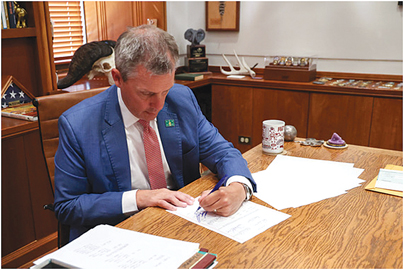
Governor Kelly Armstrong last week signed legislation that bans the sale, possession and use of synthetic kratom products in North Dakota and restricts the sale of natural kratom products to those ages 21 and older while also requiring accurate labeling. House Bill 1628 received final passage Friday morning, concluding the Legislature’s three-day special session.
“We are here to address a public safety and a public health issue that simply cannot wait for the regular legislative calendar to run its course,” Armstrong said. “People were overdosing and dying from a product they could buy off the shelf without any regulations or age restrictions. That’s why we took it off the shelves until you all could convene.”
Armstrong issued an executive order on August 3 calling lawmakers to convene September 2, declaring a public health emergency and temporarily banning the sale, use and possession of all kratom and kratom products in North Dakota as of August 5. He also signed an emergency rule issued by the North Dakota Board of Pharmacy classifying several kratom-related, opioid-like compounds as Schedule 1 controlled substances. The rule aligned with the timing of action announced in July by the U.S. Drug Enforcement Administration (DEA).
The governor asked lawmakers to codify the emergency rule in state law, clarify the enforcement authority and set reasonable criminal penalties for the purchase and sale of synthetic kratom. He quoted the DEA stating, “the aggressive marketing of these semisynthetic opioids as ‘precision-formulated products,’ ‘botanical extracts,’ or as ‘mood boosters’ for the treatment of health conditions is deeply concerning. The branding creates a false sense of safety for unknowing consumers who may equate the term ‘botanical’ with lower risk.”
Armstrong asked lawmakers to go a step further and ban kratom in all its forms as nine other states have done, with a ban on sales also set to take effect next July in Kentucky. The governor noted kratom is not regulated or approved for any use by the U.S. Food and Drug Administration, and the FDA continues to warn consumers not to use kratom “because of the risk of serious adverse events, including liver toxicity, seizures, and substance use disorder.”
“At the very least, we should have a 21-and-older age restriction on purchasing kratom, and a truth-in-labeling law so consumers actually know what they’re taking,” Armstrong said, though he questioned whether an effective labeling law is even possible without federal regulation.
Armstrong said he empathizes with those addicted to kratom products, noting the state’s Behavioral Health Division has an entire page of addiction recovery resources available at hhs.nd.gov, along with eight state-operated Behavioral Health Clinics across the state and a directory of local treatment providers. Counselors are available 24/7 at the 988 hotline for those experiencing a behavioral health crisis.
Since 2019, North Dakota has received reports of twenty-three deaths in which kratom’s main psychoactive component, mitragynine, its trace compound 7-hydroxymitragynine (7-OH), which is marketed in concentrated form, and/or the semi-synthetic analogue mitragyninepseudoindoxyl, were listed as part of the primary cause of death, according to the state Department of Health and Human Services (DHHS).